
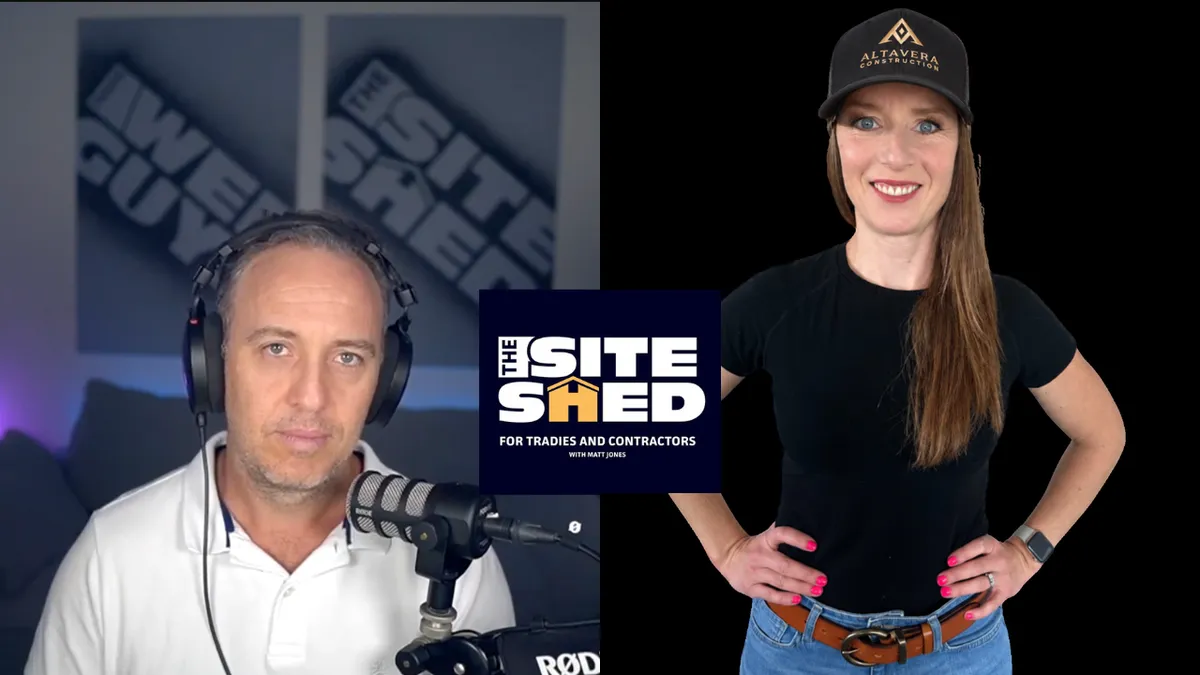
Escaping 100-Hour Work Weeks: Liz Chism Featured on The Site Shed Podcast
Most contractors start their business with one goal: freedom.
Freedom of time.
Freedom of income.
Freedom to actually enjoy the life they’re working so hard to build.
But somewhere along the way, that freedom disappears.
The business grows… the hours grow… the chaos grows… and suddenly you're the bottleneck, the firefighter, the chief problem-solver, and the only one who knows how to keep the whole thing afloat.
That’s exactly what we unpack in my recent appearance on The Site Shed Podcast with Matt Jones (Episode 475).
From 100-Hour Weeks to a Business That Ran Without Me
In the episode, I share the full story of how my husband and I scaled a multimillion-dollar craft brewery, and how that journey revealed the systems, clarity, and leadership required for contractors to scale without burning out.
Just like construction, brewing is an art and science. And when everything lived in my head, I became the bottleneck. The result?
100-hour weeks
Burnout creeping in
No space to think, lead, or grow
A business fully dependent on me
Sound familiar?
Everything changed when I learned how to:
✔️ Document what was in my head
✔️ Build systems my team could actually follow
✔️ Delegate ownership, not tasks
✔️ Create structure so the business no longer needed me to survive
Those same principles allowed us to take a two-week international trip with our phones off… and come home to a thriving business.
Why So Many Contractors Stay Stuck
We also dove deep into the four major reasons contractors get trapped in the day-to-day:
1. The Chaos Tax
Chaos is one of the most expensive costs in a construction business. When everything is last-minute, reactive, and unplanned, you pay for it in stress, wasted time, and profit bleed.
2. Estimate Accuracy Problems
Most contractors are 10–20% off on estimates, and that directly erodes their profits. One small leak repeated across every job becomes massive lost income.
3. Lack of Follow-Up & Sales Infrastructure
Most contractors don’t need more leads. They need better follow-up, better positioning as the trusted adviser, and systems that close more of the opportunities already in front of them.
4. No Clear Roles or Accountability
If everyone does a little bit of everything, no one fully owns anything. Without clarity, accountability, and structure, the owner inevitably becomes the one holding it all together.
Why This Episode Matters for Contractors
If you're a contractor who feels:
overwhelmed
overworked
stuck as the bottleneck
unsure how to scale without everything falling apart
this conversation will give you clarity, confidence, and a practical framework for creating a business that works without you doing everything.
We talk about:
✔️ Systems that drive profit
✔️ Scheduling that prevents scope creep
✔️ Team structure that eliminates chaos
✔️ How contractors can charge more and still win the job
✔️ Why clarity, not more effort, is the path to freedom
Watch the Full Episode
👉 Click here to watch the full interview on YouTube
If you’re tired of working nights and weekends… if you want a business that grows without consuming your life… this episode will give you the roadmap.
Ready to Build a Business That Runs Without You?
If this episode resonated with you, and you're ready to:
reclaim 10–30 hours per week
build a team of A-players
increase profitability
eliminate chaos
and finally operate as the CEO (not the laborer) of your business…
Then it’s time to check out the Contractor Roundtable Mastermind.
This is where contractors doing $1M–$5M come to systemize, scale, and build a business that runs without them, in the next 12 months, not the next 12 years.
👉 Learn more about the Contractor Roundtable Mastermind
Key takeaways from the episode
[1:11] Liz introduces her work as helping contractors scale, after the brewery years that taught her systems and trust in people.
[0:02] She describes the aha that you can scale and still keep the art and heart of the craft if systems and people are in place.
[9:15] She runs profit audits across about 6 months of jobs. In one remodeler example, bathroom work was clearly the most profitable.
[25:13] She stresses measuring net profit dollars month to month, especially when prices rise and close rates may dip.
[3:11] Early on she worked in the business, not on it, doing everything herself for years before redesigning how it ran.
Questions answered in this episode
How does Liz help contractors scale?
By building systems and people so the company can grow without the owner living inside every task.
What is a profit audit?
Looking at profit by job type over a span of months to see what actually makes money. In one case bathrooms won.
What should owners track when raising prices?
Net profit dollars month to month, not only top-line jobs won, because close rates can move when prices go up.
What was wrong with her early years?
She worked in the business doing everything herself. Scaling required systems and trusting people.
Full episode transcript
Transcript cleaned from YouTube captions. Speaker labels only where clear. Bracketed [unclear] marks uncertain words. Liz Chism's wording is kept as spoken.
[0:02] And that was kind of an eye-opening aha moment of we can do this. We can scale. We can have that life and have a business and trust our people and have systems and processes but not lose the art and the heart and the soul of the beer and the community and the culture that we were creating. And so about that time I had contractors and different businesses come to me and like, "Okay, how did you do that? Cuz we see you with a kid. We see you traveling. We see you hanging out in the tasting room. We see you throwing these events, but you're not stressed. you're not working a lot of hours, you're like hanging out, you're going on trips, like what did you do? And so that's kind of when it birthed a program where I was helping different people, contractors mainly, really systemize their business and make money along the way and really calm down the chaos.
[0:48] Host: Liz Chism is a lifelong builder and entrepreneur who turned a 100hour grind into a thriving systemized business. After growing a multi-million dollar brewery, she now helps business owners escape overwhelm and build companies that run without them.
[1:11] Liz Chism: Yeah. So, I'm Liz Chism and one of my main things that I do is basically help contractors scale. And how I got here is kind of a long story, but it's a really funny one and it kind of helps set the ground for what the the different topics we're going to talk about today. So, I grew up in construction. My dad's a third generation contractor and before the show we were actually talking about my kids and his kids and the fact that I homeschool and it's nothing as a surprise because I was also homeschooled and that gave me the privilege to work with my dad 2 to three days a week starting at 9 years old. Now my parents didn't believe in allowances but my dad believed in paying us if we worked for him. So it was kind of the way to make money as a kid is to go work for dad. And so I grew up swinging
[1:54] hammer. Uh he was a floor covering contractor for a while. So I started doing that. Then he started building custom homes. So I've helped him build many of custom homes. I remember when I was about 14 years old, I started taking over his QuickBooks. And it was on those big old computers that were a dinosaur compared to what we use now. And I'd go in there and I'd pay people and I'd run payroll and I'd put in the bills and I'd put in the receipts and all that type of stuff. And so I've really been in the construction industry for about 30 years. Um I know I don't look that old, but you can do the math. So, uh fast
[2:28] forward to meeting my husband. Uh my husband's actually a contractor, too. Uh and he grew up in the trades and we decided to become home brewers. So, we kind of shifted gears, went out of construction, built a brewery, built um
[2:43] a multi-million dollar award-winning, internationally award-winning brewery, and I was the head brewer. >> So, I did all the beer making. I did all
[2:52] of the operations. I did all the recipe designs. We barrelaged. We created sour beers. Yes. [laughter] This is why I had to tell you the whole story. >> Yeah. Yeah, you certainly a don't look
[3:03] like a contractor and b don't look like a brewer. But anyway, you must have gotten rid of your beard. >> Yeah, I shaved right before the call.
[3:11] [laughter] So anyway, so we ran that for 5 years and I was like anybody else, you know, you learn how to work with your hands, you learn how to do things, and so you end up doing all of it. You work in your business, not on your business. And working in your business ended up scaling my time to about 100 hour work weeks. And of course, I didn't have kids at the time, so it seemed fine. You know, I was building my dream. Uh, but then I ended up getting trapped in my business and my husband and I wanted to start a family. So, we were like, "Okay, well, what are we going to have to do in order for me to not work 100 hours a week and actually be able to start a family?" And that's when I figured out how to put systems and processes into place. And it wasn't over an overnight fix, but it definitely was a lot of trial and error of trying to get my
[3:56] employees to follow my systems and processes and try to get all of the things that were in my head and how I brewed because it is an art and a science. Same thing with construction. It's an art and a science. Like, how do you get it out so somebody can follow it? And it took us a couple [clears throat] of years to do that. But when my daughter was born and we were able to, you know, start distributing a little bit further, we started internationally distributing. So we sent a lot of beer to China and the China
[4:25] distributors actually paid for a trip for us to go out there and speak all over China and uh run a distributor
[4:33] conference. Um I mean we literally traveled all over China. And so leading
[4:38] up to that point in time required our business to run 100% on its own because
[4:45] in China, Google does not work. You don't have cell phone service and you're 17 hours difference. So your brewer calling you saying something's wrong is not going to work. Your tasting room staff calling you because a keg doesn't work is not going to work for running your business. And so we had to systemize every single area of our
[5:04] business. And we successfully went to China for two weeks, had our phones completely turned off and came back and our business was thriving when we came back. And that was kind of an eye-opening aha moment of we can do this. We can scale. We can have that life and have a business and trust our people and have systems and processes but not lose the art and the heart and the soul of the beer and the community and the culture that we were creating. And so about that time, I had contractors in different businesses come to me and like, "Okay, how did you do that? Because we see you with a kid. We see you traveling. We see you hanging out in the tasting room. We see you throwing these events, but you're not stressed. You're not working a lot of hours. You're like hanging out. You're
[5:47] going on trips. Like what did you do?" And so that's kind of when it birthed a
[5:53] program where I was helping different people, contractors mainly, really systemize their business. and make money along the way and really calm down the chaos. And so that's the full circle
[6:06] story on how I am where I am today. >> So, I've got to ask a couple of really
[6:10] important questions, especially for our Australian listeners. What type of beer were you brewing and what was your number one uh what were you known for? >> So, we were known for two different
[6:18] beers. Our IPAs, which were West Coast IPAs. I made Hazy IPAs. They're not my favorite. I am a true West Coast IPA
[6:27] fan. Our favorite one had Mosaic and Simco hops. I also like Citra hops. Um,
[6:33] but you know, that was kind of my sweet spot. Uh, it was a bully pulpit IPA is what we called it. And it was 80% mosaic and 20% simco. So, it balanced down with the fruiness and still got that like resin piny type strength behind that fruity mosaic flavor. Um, the other one was sour beers. So, we did a lot of Belgian type beers with natural fermentation, not the kettle sours, but the actual barrel age sour beers. Um, and we did a lot of bottles releases with that. And that's actually what we sent to China because it could travel on a slow boat and be
[7:09] >> better in China than it was in here
[7:11] because it had time to really sit and mature and age in the bottle. Um, so those were basically our two, but we also experimented with a lot of different beers. um in our tasting room and had a lot of different varieties just because I got bored with brewing the same stuff all the time. >> Yeah, it's interesting when I was I
[7:29] mentioned you offline like I spent a bit of time over over there and I ended up in um Washington State and right on the
[7:36] Hood River there which was as I'm told like one of the pioneering areas for craft beer back in the day on the on the Hood River there with full sale brewing and all these kind of things and it was an amazing experience that was 20 odd years ago sort of right at the birth of it all you know. Yep. >> Um, yeah. No, it's cool. Yeah, there's
[7:53] there's so many of those little micro breweries now kicking off all all over the all over the world, which has just been awesome. So, love that. Anyway, I digress. Um, I guess the um it it seems like you're there's a lot of parallels that can be drawn between um completely different verticals in relation to the systems of the thing that are going to be able to drive you freedom and success scale. >> Yeah, 100%. I mean, honestly, when it
[8:20] comes down to scaling a business, there's really just a couple of key principles that you have to think about, and it they apply to any business. Um, I've just happened to apply them to brewing and and now construction businesses, but it really applies to all of them. >> And it's understanding
[8:37] the product or the service that makes you the most money >> and going after that. The paro principle
[8:43] is, you know, says that there's 80% of your business is going to come from 20% of your clients and 20% of your business is going to come from 80% of your headaches [laughter] or the people that don't really make you a lot of money. And so really honing in and deciding what which types of services you do that
[9:03] make you the most money. For instance, I work with a contractor who did uh sun rooms, basements, bathrooms, and kitchens. So, he was kind of a general remodeling contractor and we did a
[9:15] profit audit where we figured out how much profit he made on each type of job across 6 months to really understand the averages. And >> hands down, his bathroom remodels made
[9:27] him 42%. And everything else was anywhere from 10 to 20% profit margins. And so we just
[9:35] stopped doing jobs and he just focused all in on bathrooms and his profit went through the roof. That gave him the revenue to then go branch out into kitchens at some point in time. And he's now dabbling back into kitchens a little bit more, but he has the profits. He has the business coming in. He has the
[9:54] the the revenue right there that he can then go scale and systemize something else. in instead of trying to systemize all different types of jobs, he just focused on bathrooms. >> Sure. Yeah. It's it's interesting. We we
[10:08] see this a lot um because we're also a digital marketing agency for trade businesses and when they're coming to us where like very often they kind of want to be they try to be too much to everyone, too much to too many, you know, and um so part of the journey is okay, well, how do we identify? And especially when you're talking marketing as well or especially when you're talking about like paid marketing like running ads and things like that because you it's very hard to run paid ads to general to be general like oh contact us for all of these things like whereas if it's a specific campaign that's talking to a specific service in a specific area to a specific person you know it's like a lot easier to get marketing saturation which then obviously you know lends itself to being able to you know crossell and upsell into other services which is part of that whole lifetime value um conversation. which is is not
[10:55] obvious initially, especially when people are coming to you like for leads, but it's very important when they understand that, you know, that initial job that you win from that customer is doesn't have to be the end of the conversation. >> Exactly. And that's where your follow-up
[11:07] systems have to be really buttoned up tight or else they have no idea that you can do a kitchen. You just don't advertise it. You don't lead with that. >> Yeah. Well, and this is I think as well,
[11:17] you know, like the the initial the initial point of conversation like when you're when especially from a marketing perspective, like when you're generating that initial conversation, it's like I
[11:27] think this is where a lot of businesses fall over as well in my experience, they don't they don't um they don't own that
[11:33] flag as a trusted adviser well enough. Like when people come to them and say, "I'm looking for this." They go and give them that. And truth be told, we fell into that um we fell for that problem ourselves, you know, in the early stages where people would come to us and they'd say things like, "Oh, we want a website." And we'd say, "Cool, here you go. Here's your website." And they'd be like, "Uh, well, why isn't our phone ringing?" I'm like, "Well, because you don't have any marketing." They're like, "Well, we've just got a website built." And like, right, okay. So, people think that getting a website built is going to make their phone ring. So, I I just say to you guys out there that are listening and watching this, you know, don't think for a second that you're um like people aren't coming to you as the adviser. Like, you have a responsibility and an obligation to be able to steer them in the direction of the things they actually need to get to their outcome, not the thing they're telling you they want. >> 100%. And now with Chad Chipt and the
[12:20] other LLMs out there, social media and putting yourself out there is even more relevant because SEO has gone down. I've
[12:31] seen anywhere from 40 to 70% on different statistics and chat GPT
[12:37] searches have gone through the roof. And so if you're not putting information out there for chat GPT to find it, then again, nobody's going to come to your website to look you up. >> So on that, um, I have been on the hate
[12:53] fence for SEO for many years. Um, even as a even as someone that provides that service and not necessarily because it doesn't work, but just because the the general dynamic of the results people are looking for, uh, which it is is normally more phone calls and more inquiries doesn't really lend itself to SEO. However, with the insurgence of
[13:12] LLMs over the last two years, we've seen a huge spike in SEO, which is coming through uh GEO, which is basically generative uh optimization. So, think people using search engines to ask questions. So, they're essentially treating platforms like, you know, Gemini or CHBT or whatever it might be as a point of referral reference. They're saying, "Hey, who can I speak to in this area that does this thing?" Mhm. >> And for that to happen, you need to have
[13:40] content that lives on your website and things like that which can enable the search engines to find it. So it has brought a breath of fresh air into SEO that is truthfully just so so was so
[13:50] very needed and we're seeing crazy results now from SEO as a result of LLMs
[13:56] being able to um you know send these search queries. >> Yeah. If if Chad GBT can find your
[14:03] website and look it up then it definitely works. But the people who don't put enough information out there on the way people are asking the questions, then Chachi PT doesn't know how to grab that information and then utilize that to answer the question that people are asking. >> It's funny, you know, because like for
[14:20] the last 15 years I've been running this agency, the um the the the underlining
[14:26] message has always been create useful, relevant content and just keep doing it. And for and even even before LLMs came into the picture, like if you want to position yourself as an expert, like the best way to do it is to have content that actually reflects these conversations and and trying to even, you know, from time to time solve the
[14:47] questions that people have not yet answered. So, you know, conceptually, if somebody comes to your website or they see a YouTube video or whatever it might be or an Instagram post or whatever and it's like about a question that they might have and you can solve that question, then straight away, you know, even though even though it's a very hard thing to measure, you are they you've moved them further along the buying sales cycle than someone that hasn't consumed that content. And so being content has always been the backbone of all of these things. And for so long it kind of got relegated uh with all of the things that you can do to improve results on things like SEO and all this kind of stuff. Even running ads truthfully like ads is kind of a shortcut >> to you know to
[15:29] >> like to to to mask what is really
[15:31] important which is okay how do we become a trusted you know adviser in this space. Ads is kind of a shortcut to get people to there but you still need to have that stuff there if you want to improve your conversions >> 100%. and and it and it's and now with
[15:44] LLMs now all of a sudden people are going, "Oh this is actually this is actually what we still need to be doing here or we need to go back to doing this thing." But it's never really changed. Search engines still value good content. They value recency, frequency, relevancy. >> So,
[15:59] >> yep. And that's why I also teach how to
[16:02] basically take blog posts but make them
[16:05] into videos. So the owner or the person
[16:08] who's the face of the company is in front of a camera to build that trust and they provide value and then instead of putting those videos as ads saying hey click this button to book a call to schedule a free estimate to get a free quote to whatever it is there's actually no call to action. We just run them as video view ads. And so that's how we can actually build a huge audience on social media that's super cheap. So, some of the guys like I've got people who um own a deck company and they ran just a valuebased one and a half almost two minute video and we did it as a video views campaign on social media and
[16:48] people saw that video. There's no call to action on the video. There's no button to push. They went to his website and he got four leads and closed one of
[16:56] them and scheduled the job because people are like, "Wow, you're actually providing value. You're not trying to just say, "Hey, I'm the best. I'm the best. I'm the best. Hire me. It's actually like, oh, you actually understand the process. You've built trust with me. You've put your face in front of the camera, especially with everything written by LLMs these days. You can spot it a mile away from what's actually just Chad GPT generated, but it's actually the guy talking. It's like, "Oh, wow. He actually knows his stuff." And they've been able to get a lot of leads that way. >> Yeah. And then and this I mean we're
[17:31] probably segueing a little bit but it does sort of you know for for years we've been I've been talking about like the ecosystem of search and [snorts] essentially you know the how you know you've got direct direct marketing which is kind of like okay whatever we're doing here to like get gain the lead and then you kind of got brand awareness marketing which is okay well then once we gain the lead what are we doing in terms of strengthening our position and likelihood of them becoming a client and it's it's extremely relevant when you're talking about project based verticals like you mentioned your other client with bathrooms and kitchens and renovations and those kind of things because they're not such a reactive service where somebody's like oh my god I need to get my bathroom re renovated tomorrow as as you know whereas blocked drains are like well my drains are blocked I need someone here within the within the hour you know
[18:16] >> exactly
[18:18] >> so there's there's definitely a lot of
[18:19] opportunity to unpack there and you know it's something that you know I've definitely been super passionate about over the years and helping businesses develop and scale and tying in you know the obvious things which is okay well you know we can run some ads here and generate you leads but then the non-obvious things are okay well what's happening after that lead's been generated and one of the big things is first of all as we've discussed the you know building trust and rapport and positioning yourself as a trusted adviser but then the other the other thing is the system behind uh managing
[18:48] the leads and and the sales and like
[18:52] that's probably that's sort of where we positioned ourselves in the marketplace because truthfully generating the lead is not the hard part but improving the conversions along that journey is really where the power comes into that whole conversation around, you know, converting more out of what you currently got with leads. >> 100%. Yeah, there's there's a couple of
[19:12] black holes within the client acquisition system. There's the black hole of getting a lead but not following up. And most people don't follow up. Um,
[19:24] and statistically people take at least 7
[19:27] to 11 times of followup to convert. Um,
[19:33] I've also seen statistics where people need to see uh uh 7 hours of content
[19:39] over four plat 714. >> Yep. Um, over four platforms and over 62
[19:45] to 67 days. Maybe it's 63 to 67 days.
[19:49] Like it takes a while for people to realize like is this somebody I should trust or is this not somebody I should trust. But once they become a lead and you followed up with them, then the next black hole ends up happening when you go and do an estimate and you look like everybody else. And so unless you're the cheapest contractor, you may or may not get the job. And so how do you build trust at that point in time? Um and so some of the things that we do is again more video because you talk through the estimate. You record the estimate. You send notes about what you're going to do and how you're going to do it. And people go, "Oh, yeah. You did catch my vision. You do understand what I want." And that's going to build rapport versus, "Oh, this one guy, I don't know if he's going to actually do the work that I want him to do." He's saying,
[20:35] "Oh, yeah, I can do it. I can do it." You know, but people don't really want to hear yes, yes, yes. All the time. They want to make sure that you are actually understood. Um, and so once you get that, you can then charge whatever you need to charge because you've positioned yourself as the trusted contractor who's going to fulfill the work the way that is dreamed about by
[20:55] the client. >> Yeah. Exactly. Don't tell me, show me.
[20:59] >> Exactly.
[21:00] >> Mhm. Yeah. So, it's yeah, it's good that
[21:02] we have the similar sort of experiences in different markets because it's um [laughter] I feel like sometimes when I I say these things to my clients and they it's sort of like coming from their dad. They just don't want to necessarily hear it. But what's good having it um enforced by someone else [laughter] >> 100%.
[21:20] >> So, um I know you mentioned uh in the
[21:24] leadup to this podcast, we're going to be discussing some things around chaos tax. Yes, it's a probably one of the
[21:32] biggest taxes that contractors pay
[21:35] because their business is so chaotic
[21:38] >> and they don't have time to make a
[21:40] schedule. So, everything's fly by the seat of your pants. There's no systems in place. Um, and that always leads to
[21:48] not knowing your numbers and chasing after the wrong types of clients because you're always in this desperate type last minute mode. And so you can't actually take a step back and go, okay, who do I really actually want to work for? And what types of jobs do I really want to do? And then to do a cost, which
[22:08] is some of the most challenging things for contractors to do, but to look back at their last jobs and go, did I make money? And if so, how much? So one of
[22:18] the exercises that I have contractors do is go through and figure out their estimate accuracy. So basically what is their estimate and what was their actual job cost and compare the two and typically I see anywhere from 10 to 20%
[22:35] off. So if you charge if you were doing a remodel job and it's $100,000
[22:41] just for kicks and purposes. Obviously my math is a little off but let's say it cost you $110,000 that's approximately 10%. or if it cost you $120,000, that's 120%
[22:54] or 20%. And so if you actually can
[22:58] recapture the accuracy, you can add 10
[23:01] to 20% to your bottom line just by buttoning up any holes that made it not accurate. And sometimes it's just comes down to you needing to charge more. >> Uh there was one painting contractor I
[23:13] worked with and they were off at least 5 to 7% on every single job. It didn't matter what type of job it was. It didn't they were did commercial and residential. It didn't matter if it was outside or inside. They were always off 10 to 7 or 5 to 7%. And so we just added
[23:30] a buffer line in their estimate. It just bumped up the estimate 5 to 7% and all of a sudden they were making a lot of money because they weren't losing that every single time they did a job. >> Yeah. Yeah. Yeah, it's interesting
[23:45] actually when we're working with um clients [clears throat] that have primarily and this is most of the most of the time to be honest like they've coming out of that >> uh word of mouth referral-based
[23:55] um sort of business which has got them to a point but it's very hard to scale that. So when they come to us they say okay we want to we want something that's more scalable something we can help predict our growth help us predict our recruitment processes and all of these kind of things right so you know when we're deploying these systems for businesses one of the first conversations we have to have is in the space of uh profitability and net profit left over and because especially when you've got um a business that's grown to a certain point organically without having to have the uh any need for
[24:27] marketing budget you know and and and for people going the grow the paid traffic route they need to make sure that as part of their operational expenses they have allocated marketing budget and very often they don't and through no fault of their own I I should add but it's important that when you guys do decide you want to go down that route uh and you want to use paid traffic as the me as the vehicle to you
[24:49] know to to scale you do incorporate these necessary expenses into the pricing of your job so that you are constantly fueling the engine >> 100% [clears throat]
[24:58] >> and it's very very very common for
[25:01] businesses to sort of, you know, and we see it all the time. They're like, "No, no, we don't we don't do up our prices. We're good." I'm like, "You will need to up your prices." And of course that comes with um uh rejection as well in
[25:13] terms of jobs being accepted because all of a sudden your prices have gone up 10%. But you still need to make money, right? So, that's why it's important, like we say to our guys, you need to measure your your net profit dollar um monthto monthth and you need to measure your net profit percentage ratio and you got to make sure that they're both, you know, scaling accordingly because they're not always indicative. >> Yeah, we use a dashboard that I made
[25:36] that turns all of their numbers into percentages. So, if your revenue went up, but your marketing percentage-wise
[25:45] didn't go up, then you need to go, okay, well, what did we do? Why is that? Or if your marketing goes up and after a month or two your revenue does not go up, then you know that the marketing percentage is not actually contributing to the growth because >> numbers you're not charging.
[26:01] >> Yeah. Exactly. So numbers can lie to you
[26:03] and it's really hard to tell the ratios of numbers versus when you see percentages you can see okay if this went up and this didn't go up then what needs to change in order for our revenue to go up based on these behaviors. Um so yeah I put everything into percentages so that you can have a clear picture on what your numbers are. I mean the data is the data is paramount and without the data you really don't have any way of identifying you know where the where the
[26:30] where the levers are that could be pulled in order to steer the ship in the right direction and truth be told it's in most cases a scenario of like momentum will drive direction like you need to get the thing moving to identify where like which levers need to be pulled and some of those levers are we need to increase our prices or you know we we need to spend more and that's a really common obstacle that we see as well like businesses you know, will come to us and they say, "Well, this is, you know, when we create their road map or whatever, this is where we want to be." I'm like, "That's fine, but in order to get to that point, you need to understand you need to be spending at least this much to get there." >> And sometimes that's like a sledgehammer
[27:04] to hit them. They're like, "What? That much?" And I'm like, "Yeah, because that's just the figures. You just got" and I'm like, it but I think a lot of businesses do, they kind of think, oh, well, that means I need to have that money saved and I need to be spending it. I'm like, no, no, that's not how it works. I You just need to allocate for it within the cost of your jobs. There needs to be allocation in there so that looking forward, you're always fueling the engine. You don't have to have it saved. You just need to make sure it's allocated looking forward. >> Yeah. One of the biggest ways that I
[27:29] find contractors losing profit is not
[27:33] knowing how much their time is worth. So therefore, they do work that's not leading to the bottom line of their business. So, the [clears throat] classic example is running out to Home Depot or Lowe's or, you know, the local supply store and picking up supplies for their job site. >> And instead of spending time focusing on
[27:53] the numbers and understanding where the profit leaks are, they're sitting in line at a register waiting to spend a couple hundred when they should have just paid their employee to go to the
[28:05] store and get the thing and then go back. And you know, and then same thing like one of the first things that I have contractors do is hire a virtual assistant. They can take all the receipts and input them into the system. They can take all the numbers and put it into the spreadsheet. And so all you have to do as an owner is look at it. You don't actually have to gather it because that takes a lot of time and a lot of energy and effort and usually is the least favored job for contractors to
[28:33] sit there and punch the numbers. but they can look at it and go, "Oh, actually that doesn't look good." And so, you know, they end up hiring the wrong person. Because if a contractor goes and hires a project manager because they're managing the jobs and they're like, "I just want to get off the tools." Then what they end up doing is running to Home Depot and putting in their receipts and paying their bills, which somebody should be doing for them before they get to that project management state. And so, hiring the wrong person. And so you're not really valuing your time can be a way that you end up just pulling yourself into more debt and less profit because you're paying for the wrong things at the wrong time. >> It's a it's a really important
[29:14] conversation that we have to have with clients at the beginning of the process to when we say to them, listen, when we once we deploy this, you are going to inevitably have to take one hat off and put another one on. And what because essentially they what's got them to where they are you know for better or worse uh is not going to get them to the next stage which is going to inevitably involve [clears throat] them excuse me
[29:38] spending time >> on things that are more valuable to the
[29:41] business and more important to the outcome which they've defined. And one of those things that we see very very often in almost every scenario is the fact that they need to be focusing their attention on like sales and closing the jobs rather than being out on on the job doing the thing. That's a really common scenario. So we're like, okay, inevitably you're going to have to sacrifice some time on site here to be servicing these leads and closing more jobs so we can bring more people in that can do, you know, so on and so forth. So often it means developing and um you know team members that can manage the sites and the jobs for them you know recruiting and all these kind of things that are not necessarily obvious in the early stages. Uh there sometimes they think the answer to all their problems is is more leads and it's often the cause of most of their headaches if they
[30:27] don't have like the right sort of stepping stones in place along that journey. >> Yeah. One of the things I have
[30:33] contractors do um when we're starting to look at their numbers and they don't really know much. They're like, "Look, I'm making money. Look, it looks great on paper." But what they don't factor is the fact that they are wearing that many hats. And so, they should be paying themselves for that project management hat when they're on the job site and then taking that off and putting their accounting hat on when they're punching the numbers and then taking that off and putting their CEO hat on. And so they're only paying themselves one salary, but they're not allocating enough money within their job, within their business to pay for anything else. And so there is no money left over to pay for a project manager or to pay for a bookkeeper or to pay for anybody else. And so what I tell them, I'm like, you have to pay a project manager for this
[31:20] job. If you work 15 hours on this job and you're going to pay a project manager x amount per hour, then that money is going to be charged to the job and put in a savings account for when you hire someone because then you have the money there and as they ramp up and, you know, actually take over the responsibilities that they need to. There's obviously that training period. You have the money to pay them while they're training and you're not scrambling going, "Okay, now I'm, you know, I got to make more money. I've got to be doing the the sales. I've got to be paying these things. And all of a sudden, it's just more chaos. But planning ahead is one of the hardest
[31:57] things for contractors to do, but it's actually one of the things that reduces the chaos in their business so that they can scale without the chaos.
[32:06] >> It's also insanely refreshing once you
[32:08] do create a plan how easy it is to reach your outcome. And you know, I've been through this myself over the years where I was like, "Wow." Like, so all I've got to do to get to that is these things consistently. You know, it's not like sometimes it seems like it's this outrageous, you know, target and goal, but realistically it's just like doing the small things consistently and having a plan around doing them. And, you know, it's it's quite a revelation to to to businesses when they when they I can see that actually in in action. Yeah, I'm huge on cadence. Like, how do
[32:45] you actually implement these into your everyday lives? >> What needs to happen? So, I was on the
[32:51] call with one of my clients today and he
[32:55] was going through what his next 90-day plan was and we broke that down into
[33:01] what he needs to do each week. And that,
[33:05] you know, at the end of the call it was like, this is what I have to do this week. And I was like, "Okay, so when are you going to actually do this this week?" Because we can say, "Oh, yeah, we are going to do it, but if we don't put it into our schedule and put it within the rhythm of our day, then it won't ever get h it won't ever happen." They've done studies where, you know, they had two different groups of patients who had knee replacement surgeries. And one group, they just handed them the manual and was like, "Here's the exercises you need to go do when you get home, and you know, you'll recover from your knee replacement surgery." And they just handed it to them. And in construction, it'd be like handing your employees some SOP that you wrote and hope that they actually read it and follow it. Uh the other group of patients where that had knee replacement surgeries, they said, "Okay, here's the
[33:50] exercises that you need to do." And then when are you going to do them? Oh, I'm going to do the standing and sitting three times every time I sit down and eat food. Okay, so that's attached to a habit that's meal time. And then I'm going to walk the block because I'm going to go check the mail that's down the street. Instead of driving there, I'm going to walk there. And so in their minds, they had the plan that was attached to their daily rhythm. And so with that, they looked at these two separate groups of patients and the group of patients that were just handed all the exercises, never did any of them, and their knee replacement surgery was not successful. And then the other group where they just walked through just a couple minutes of like, when are you going to do this? How is this going to go into your daily life? They were
[34:36] wildly successful and recovered excellently from their surgery. And so every time I put in a system, instead of just overloading, it's like, okay, we're going to do this, this, this, this, this, this, this, and here's this long laundry list of stuff that you got to do for your business. It's like, okay, what are the one or two things that you have to do this week that's going to get you to your goals? And it's, you know, for this particular client, he's trying to get bigger jobs. He's a commercial contractor, and it's like, okay, so if we want to get to our goal, then we need million-dollar jobs. We don't need $100,000 little tiny jobs. we need million-dollar jobs. Like, okay, who do you have in your pipeline that are those types of jobs? It's like, oh, okay, these people. Okay, so we got the people. We know who we're going to contact. And then I said, okay, when are you going to do it this week? He's like,
[35:23] uh, it's like, yeah, it won't happen if you don't put it into your calendar. If you don't put it into a rhythm, if you don't have that cadence that happens on a weekly basis that your day and your week and your month becomes predictable. Every Tuesday I do this. Every Wednesday I do this, every day, you know, at the beginning of the day we do a 10-minute huddle. At the end of the day, we log in all over, you know, on the job log. Like, if you don't have that rhythm in place, then really any system doesn't have anything to stick to. And so therefore, it just continues to be chaos. Yeah, it's it's interesting you say that because it's this we we've James James James Clear um coined that as habit stacking to a degree like his book atomic habits. For you guys that haven't
[36:08] read that, go check it out. But um like
[36:11] essentially it's about okay, how do we create good actions which can result in helping us move closer towards the you know the goals that we've set so on and so forth. Uh we see it a lot with um and it's true exactly what you're saying when you know if it doesn't be if it doesn't doesn't become part of the process it will never get done and it will always get relegated on the list of important things to do if it's not part of the process or the job finish checklist for example you know part of this job is for you guys to take photographs that we can use to promote like use for marketing like if that's not part of a checklist it just won't get done >> and if part of that checklist is is you
[36:46] know if if we need you guys to you to, you know, get a review from your customer. If that is not part of your checklist, you just won't do it. And you'll always relegate it on the list of important things to do behind going to the pub on Friday afternoon, you know, with with the boys. So, you know, it has to become part of the process for it to get done. Absolutely. And just sort of circling back as well to the what what you were saying about the um uh like like in my mind I heard it as like financial illiteracy but essentially again like respectful of the fact that a lot of the contractors and and I was one of them as a former plumber you go through this system and you're never really taught these things. you have to sort of go out there and learn them on your own and financial literacy was absolutely you know is one of the biggest things that I see today that businesses just don't really fully
[37:32] understand but they can learn and truth be told credit to a lot of the guys out there they go and do take it upon themselves to learn these things but there are systems out there which do simplify and I think profit first um is one of the best systems that I've seen for like just for simplifying finan financial management and just making sure that that scenario which you talked about which is we don't have any money left over for this like that never becomes a reality when you're running profit first because there's always money available uh being allocated out of the job pricing and things like that. So, it's just a really simple stepping stone to help businesses I think get a basic understanding of of these things. >> Um
[38:08] >> yeah,
[38:08] >> a lot of people that educated in the
[38:10] financial space don't like it. They're like, "Oh, no, it's it's not." But like from someone that hasn't come from a financial background, like I see a lot of advantage with it. >> Yeah. I actually like to take profit
[38:21] first just even one step further and decide ahead of time what your profit's going to be and then just make an automatic transfer that happens every month. So instead of looking at your finances and going, "Okay, I'm going to take my profit out and then I'm going to pay this and everything's separate." It just automatically goes. You know, if you're a million dollar business per year, you know, you do the math, that's per month, you know, 80s something thousand. And then if you want 15% of that, then 15% of that every single month just goes away into an account. And so there's actually less guesswork. Um because I find that contractors,
[39:00] unless they've delegated that to somebody else, they look at their numbers and they're like, "Yeah, but there's no way I can put that money into this account for profit because I just" and and then they like freak out because they don't trust the process of saving
[39:16] that profit. and paying that profit first so that they can then run their business on what's left over. >> Yeah, I'm not sure if I agree with that
[39:25] to be honest because I think we see it a lot with project based businesses where they'll have some months that are like quite large and they'll have quite a large allocation there. It's always an allocation. So, it doesn't make any difference and the next month it's still the same allocation. So, it's still getting allocated regardless, but it's just not the same dollar amount. And if they did put all of that money into profit and there wasn't any money left over to pay their team, then that'd be a problem. >> Yeah. I guess it just depends on the
[39:48] type of jobs, you know, usually they've got multiple jobs going on and they're staggered, so it actually works out. But as long as you're doing it >> and you're putting out profit that's
[39:59] going into a place that you're not going to just use and touch all the time, then
[40:05] that's the most important part. >> Yeah. Sure.
[40:10] Um what are some of the other things we're going to discuss here? Um, we're going to talk about
[40:20] um, let's see.
[40:35] Be good to unpack, I think, some of the dynamics around um,
[40:43] project timelines [snorts] and like deadlines that come into like realistic and unrealistic project deadlines to to manage funds and manage costings appropriately. I see a lot of businesses sort of blowing out on scope creep and things like that. Um, and at the end of the day, as a result of poor
[41:02] data, um, not not setting realistic expectations, maybe putting too much strain on, you know, fulfillment teams where they shouldn't be. >> Yeah. So, scheduling is probably the
[41:18] biggest hurdle with fulfillment and one
[41:22] of the the biggest complaints from clients. So, even in my circles of just
[41:27] talking to homeowners and them talking about how they hired a contractor and that the contractor said it would take 3 weeks and 3 months later they're still under construction. Uh, is definitely a big huge thing that needs to be systemized. I think a lot of times it comes down to a couple of different things. One, contractors schedule jobs
[41:48] as if nothing is going to go wrong and everything is going to go perfect. And then I also think that
[41:57] realistically they schedule jobs based off of time, especially if it's somebody that is new on the scheduling side of things. So let's say the owner was doing it a lot and then they've delegated it
[42:09] to somebody else on the team. You know, if it says, oh, this is going to take 16 hours, that could be two days. But if
[42:17] they're drywalling, mudding, they're not going to start on the next phase if they've got 30 minutes left over of the day. And so that two days or that 16
[42:29] hours actually could turn into three days because of the timing of the type
[42:34] of work that you're doing. Like you're not going to start on something with an hour or two left in the day because then by the time you set it all up, you've got to go turn around and go clean it all up. And so really understanding how much each trade or each scope of work is
[42:51] going to take is important. And I think one of the biggest things too is there's really no end date that people are talking about. Um at least AC across the contractors that I work with, I'll ask them, okay, when is this job going to end? Well, I don't know, a month or two. [laughter] It's like, well, is it going to be a month or is it going to be two months? Or is it going to be three months? Like when is that end date? Because the Parkinson's principle says that things are going to swell to the amount of time that you give it. So if there's no end date, then things just kind of swell to whatever time you decide to give them. And there's really no urgency among the team to get the work done. And so it's like, oh well, we kind of need money over here. We need to get this job over there, or this client's mad over here. And so you shift your team because you didn't really have
[43:38] an end date anyways and you're hoping the client's not going to be too mad at you and you're not really sticking to that schedule. And so going, okay, what is that end date that we're shooting for? And obviously that can change with change orders, but when is that end date? And then bonus on top of that. So
[43:55] like if you finish a day early, then how much profit extra profit are you making because you actually did finish early. And then you can split that among the team. Usually like 33% is a good amount
[44:07] to give to the team and then keep the the other 60 you know 6%. But be able to
[44:14] really know what that end date is and then every single week depend or you know even every day depending on how long your jobs are compare the progress to that end date and go okay is this going to be hit or do we need to make adjustments and then have that feedback loop of wow anytime we have a job that's going to be this scope we need to make sure we add a couple extra days. And so when you start learning from the past and you start having a really strict end date, magically somehow jobs actually
[44:43] end up finishing on time because everybody knows what that is and you've aligned everyone's goal to that end date. >> It's interesting actually. Yeah, I I did
[44:54] a podcast um back in March with um
[44:58] Katherine Howard, who's the CEO of um
[45:02] um Lee's uh air conditioning in um
[45:09] in Fresno, California. and um her they
[45:13] doubled their business from 30 million to 70 million or something along those lines um organically in the space of 12 months and they didn't put any more team on. In fact, they took one of their fulfillment team members out and I was asking her how she did that. She said, "Well, basically you people will people will do
[45:32] what you pay them to do." So, you know, before you know, we were just paying them to show up and work their eight hours or whatever. Uh and then when we went to them and said, "Hey, would you work twice as hard if we paid you twice as much?" And they said yes. And so all
[45:48] of a sudden then the the dynamic within the business shifted from okay well you're here to do your 8 hours of work to here you're here to deliver this outcome and they pretty much doubled their capacity and they were getting paid a lot more to do it but everyone won. And so that conversation around incentivizing your team members I think is really important and and it's one one lesson that I've learned as well like your team members will do what you pay them to do for better or worse. If you pay them to show up for eight hours they'll do it. If you pay them to do a certain thing and you incentivize them for that then they'll also then they'll do that and it's quite empowering that way because you don't really put a cap on them financially when you do have a model around that that works really well. [clears throat] >> Um we do a little bit of both. So, it
[46:28] kind of depends on the trade. A lot of them,
[46:34] >> well, by law, you have to do both. You
[46:36] can't just, >> especially in Australia, you can't say,
[46:38] "We're only going to pay you collect incentives." Like, you have to have an award wage. But, >> yeah. So, that's why a bonus pay or like
[46:47] a performance pay is really important. Um, but I think too just having a culture of accountability and having the communication in place is what people want. If you think about A players and A is in a grade and you don't want B players or C players, people who got A's in school wanted to know how they could get an A in school and then they worked towards getting the A in school. They didn't just randomly show up and never study and never look
[47:16] at the book and hope they got an A. It was like, no, I'm going to try hard. I'm going to study. I'm going to do the things that are necessary in order to get that A. And that's the same thing with a players in a business. You know, most people don't quit businesses, they
[47:31] quit managers. And so >> having a cadence where every morning
[47:37] it's okay, what is the goal for today? Where are we going to try to get? >> And you know, if they finish early and
[47:44] they got to the goal, then have them leave early and pay them for the eight hours that they work. Um, but have that goal. I know when growing up and I was working with my dad, it was always like, "Okay, this job we need to be completely
[47:58] demoed by the time we leave today." And I was like, "Oh, okay. I know what the goal is." And so you start thinking in your mind, "Oh, wow. We're lunchtime and we're not halfway done. We better step it up a notch because we got to get this thing demoed by tomorrow morning, you know, before we leave tonight cuz tomorrow morning something else is happening." And so we need that those milestones. But a lot of times those milestones are not communicated. And so it's really just workers float floating
[48:25] through the job site sort of working because they don't know what the objective is or what the goal is. >> It comes especially relevant when you're
[48:35] collaborating between trades. So you know we need to make sure that this is done by this time because tomorrow mechanical is coming in and they need you to be out of the way. like there there's ramifications if there's not like everyone's not in alignment there which is truthfully where some of these technologies today have such great you know such a great footprint with helping people identify you know gant timelines and you know things that have to be done on and this is where some of those bigger you know principal contractors and things like that have got such a good process in place in making sure that everyone's in alignment with what has to be done by when. >> Yeah. And honestly, even just the owner,
[49:11] if he's trying to become
[49:14] a CEO and get himself from being in the
[49:19] business and work on the business and step out of that chaos, just sitting down and scheduling out the jobs for an hour is one of the most time
[49:30] valuable things that can be done versus putting it off and putting it off and all of a sudden you've got workers coming. So then you're constantly playing catch-up and you're constantly behind and you're constantly trying to put out fires because you didn't plan accordingly. And it's not that they don't know how to plan accordingly. They just didn't take the time to actually set up the job correctly with the schedule in place, communicating everything to everybody, and then starting the job on the right foot. >> Liz, I feel like we could probably talk
[50:03] for days on these different dynamics. Um, but respectful of the time of the day and um, so on and so forth, we should probably get to uh, closing this one off. Uh, is there anything that you think that we haven't covered or anything that we should just quick cover off on before we wrap up? >> I think we've covered most everything. I
[50:21] think if you're a busy contractor in chaos, like just take a deep breath and start focusing on the most immediate constraint and work your way from there because you don't need to solve all your problems at once. Just solve the next problem. That's always my message, too. It's just like just take time to breathe and strategize. Like an hour, an hour a week, just sit down and like stick to the plan. And it's it's very refreshing how how quickly things sort of fall into place when you do do that. >> Yep.
[50:48] >> Um uh Liz, where can people get hold of
[50:51] you? >> I'm on social media and people can go to
[50:55] my website at lizchism.com. >> Cool. Um, I'll have links um, for all
[51:00] you guys out there to Liz's website and social handles and so on and so forth. So, just head across to the sideshare.com and search Liz Liz and um, this will inevitably uh, pop up with those links. So, Liz, thank you so much for your time. Listeners and viewers, if there's anything we haven't covered off on or anything you want to expand on, let us know. Um, I'm sure I can coax Liz to coming back on the show and answering some of those questions. Um, but Liz, thank you for your time. I'll let you get on with your evening. >> Thanks for having me.
[51:28] And that is a wrap. Hey guys and girls, how would you like all of the value ads left behind from our podcast guest all put together in the one spot? We've pulled every tool together, every template, every resource shared on the show, and we've packed them all into the trading academy. It's free to join and it's built by the team behind the size shed and trading web guys. Inside you'll get marketing tips, business tools, and first access to future resources all in one simple dashboard. Just head across to trady.wiki/ wiki/pod. That's tradey.wiki/pod. The links in the episode description. And once again, you just log in once and then you're all set. And if you want to get notified of upcoming episodes, hit subscribe or follow.


